
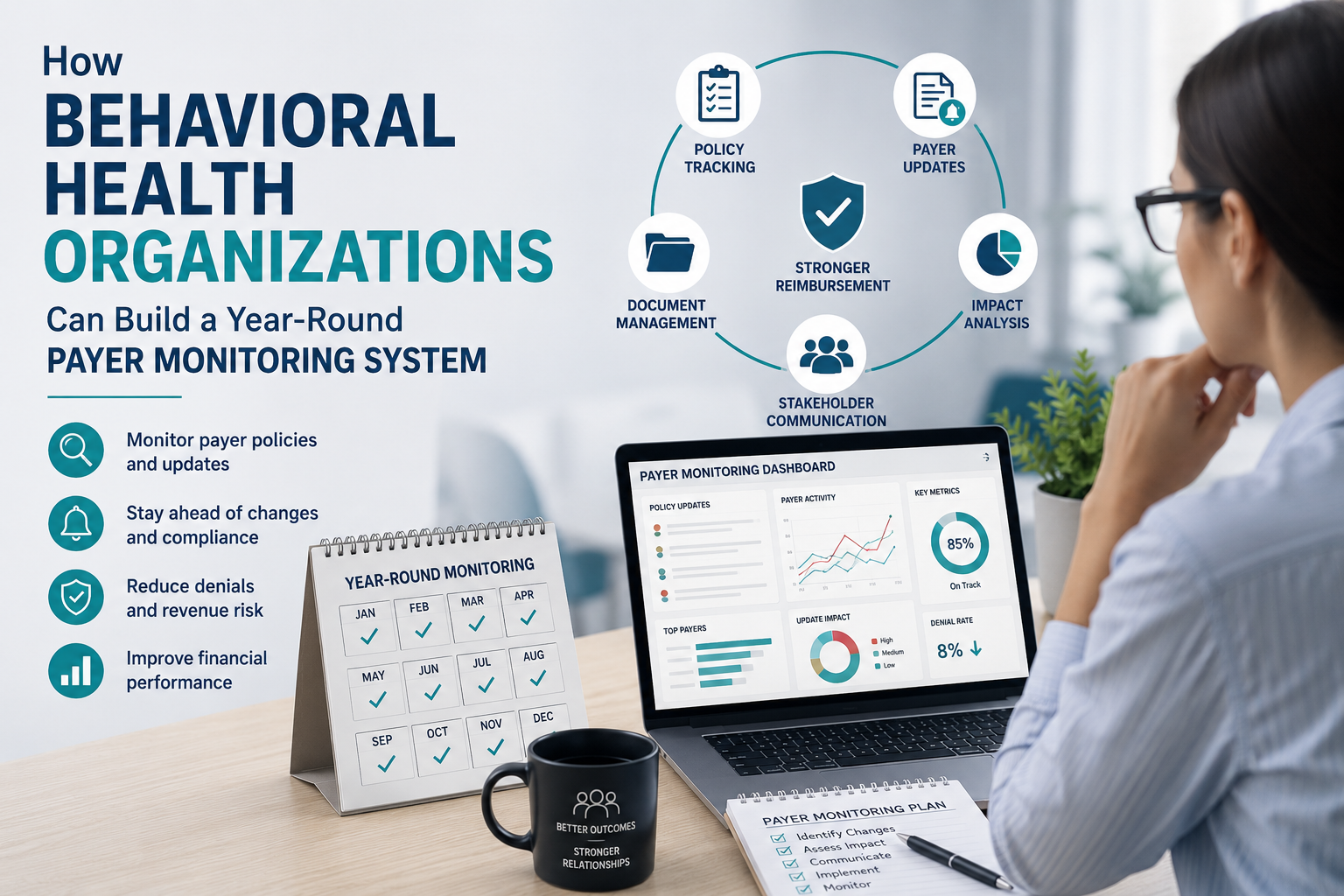
How Behavioral Health Organizations Can Build a Year-Round Payer Monitoring System
Every article in this series has pointed to the same conclusion: reimbursement changes are quiet, frequent, and easy to miss and the practices that catch them are the ones that look on purpose, on a schedule.
This final article turns everything that came before into a system. Not a one-time project, not a scramble after a bad remittance, but a repeatable operating rhythm that makes revenue integrity a standing function rather than an occasional fire drill.
A payer-monitoring system has four review cycles running at different tempos, a discipline for documenting what you confirm, and a communication loop that connects the people who see the data to the people who make decisions. None of it is complicated. All of it depends on happening consistently.
The Monthly Claims Variance Review
The fastest cycle is monthly, and it is the one that catches problems while they are still small.
Each month, pull your highest-volume and highest-revenue CPT codes and compare allowed amounts against the prior period — segmented, as this series has stressed throughout, by provider type, place of service, telehealth vs. in-office, and plan. Sort by date of service. Use the modal allowed amount, not the average.
The monthly review is not trying to be comprehensive. It is a tripwire. Its job is to surface the unexpected — a code whose allowed amount moved, a segment that suddenly prices differently, a telehealth stream that diverged from its in-office counterpart — early enough that you can investigate before it compounds across thousands of claims.
A competent analyst can run this in an hour or two once the process is established. That modest monthly investment is what converts a year-end surprise into a same-month observation.
The Quarterly Payer Posting Review
The second cycle tracks what payers publish. As earlier articles covered, payers post fee schedule updates outside the annual cycle — quarterly postings that rarely announce themselves as behavioral-health news and often trigger no organizational response at all.
Once a quarter, check each major payer's provider portal or resource center for new fee schedule postings, reimbursement policy updates, modifier or place-of-service changes, and telehealth policy revisions. For each posting: confirm the scope, note the effective date, and run the focused review the series has described — before-and-after allowed amounts on your affected codes, by date of service.
The quarterly cycle and the monthly cycle reinforce each other. The posting review tells you a change was published; the claims review tells you what it did to your reimbursement. Neither alone is sufficient. Together they close the gap between what the payer announced and what actually happened to you.
The Annual Adjustment Review
The slowest cycle is the one most organizations already do — and often the only one they do. The annual adjustment is the payer's scheduled, comprehensive revision of its standard professional fee schedule and pricing methodology.
Because it is predictable, it can be planned. When a payer publishes its updated schedule ahead of the effective date — many do, sometimes a month early — retrieve it during that preview window and model the impact before a single claim processes at the new rate. Compare the new schedule against current allowed amounts across your top codes, weight the variance by volume, and produce a projected annual impact for leadership.
The annual review is where budgeting, compensation planning, and service-line strategy connect to reimbursement reality. But treated as the only review, it is far too slow — which is the entire reason the monthly and quarterly cycles exist.
Documentation of Payer Confirmations
A monitoring system is only as strong as its record. Every time you investigate a variance and reach a conclusion — especially when you contact a payer — document it.
Maintain a running log: the date, the payer, the type of posting, the effective date, the codes affected, what you found, what action you took, and — critically — any written confirmation the payer provided. When a claim does not match the posted schedule and you request clarification, capture the payer's written response and store it with the claim details that prompted it.
This log does more than organize the present. It becomes an institutional asset. It shortens the next investigation, supports appeals with a documented history, and preserves knowledge that would otherwise leave with the person who happened to remember it. Written confirmation is what protects the organization when a dispute arises months later.
Communication Across the Organization
The final component is the one most often missing: the people who see reimbursement changes in the data are rarely the people who can act on them alone.
A working system connects four functions:
Billing and revenue cycle see the variances first and run the reviews.
Clinical leadership understands whether a coding, documentation, or workflow issue underlies a pattern — and owns any change that touches clinical practice.
Operations connects reimbursement patterns to scheduling, staffing, and delivery model, including the telehealth-versus-office mix.
Finance translates variance into budget, forecast, and strategy, and decides what a confirmed change means for the organization.
The mechanism can be simple: a brief standing review where the monthly and quarterly findings are shared, decisions are recorded, and follow-ups are assigned. What matters is that a variance found in the billing data reliably reaches the people who can respond — and that the response is documented in the same log that captured the finding.
A monitoring system without this loop produces observations that go nowhere. With it, the organization turns claims data into decisions.
Putting It Together
The complete system is a rhythm:
Monthly — claims variance tripwire on top codes, segmented, by date of service.
Quarterly — payer posting review across portals, matched against claims.
Annually — comprehensive adjustment review, modeled during the preview window.
Always — document every confirmation; route every finding to the people who can act.
No single cycle is burdensome. Their power is cumulative and comes entirely from consistency. A practice running all four will know about a reimbursement change in the month it happens, understand what it means within the quarter, plan for the annual shift before it lands, and carry a documented history that strengthens every future review.
Bottom Line
Reimbursement changes in behavioral health are not always loud. Across this series we have seen that they surface in claims data before anywhere else, that annual and quarterly postings are different events, that the allowed amount is the number to watch, that testing codes deserve their own review, and that the details underneath a code decide how it prices.
A year-round monitoring system is what turns all of that awareness into a durable operating capability. Monthly tripwire, quarterly posting review, annual adjustment review, disciplined documentation, and a communication loop that reaches from the remittance file to the leadership table.
The practices that stay financially healthy are not the ones that react fastest to bad news. They are the ones that built a system so the news never gets the chance to become a surprise.
CBI Center for Education supports the long-term development of mental health professionals through education, consultation, and research. If your organization wants to build the kind of year-round monitoring system described in this series, explore CBI Center for Education's courses, resources, and consultation-oriented support — designed to help clinicians and behavioral health organizations keep improving both the care they provide and the operational foundation that sustains it.
Compliance Note
This series is for educational purposes only and is not legal, coding, billing, payer-contract, or compliance advice. CPT coding, coverage, authorization, documentation, provider eligibility, modifiers, place-of-service codes, and reimbursement vary by payer, contract, region, plan, provider type, place of service, and date of service. Behavioral health organizations should confirm payer policy, contract terms, current CPT and modifier guidance, state scope-of-practice requirements, and internal compliance standards before changing any billing workflow.