
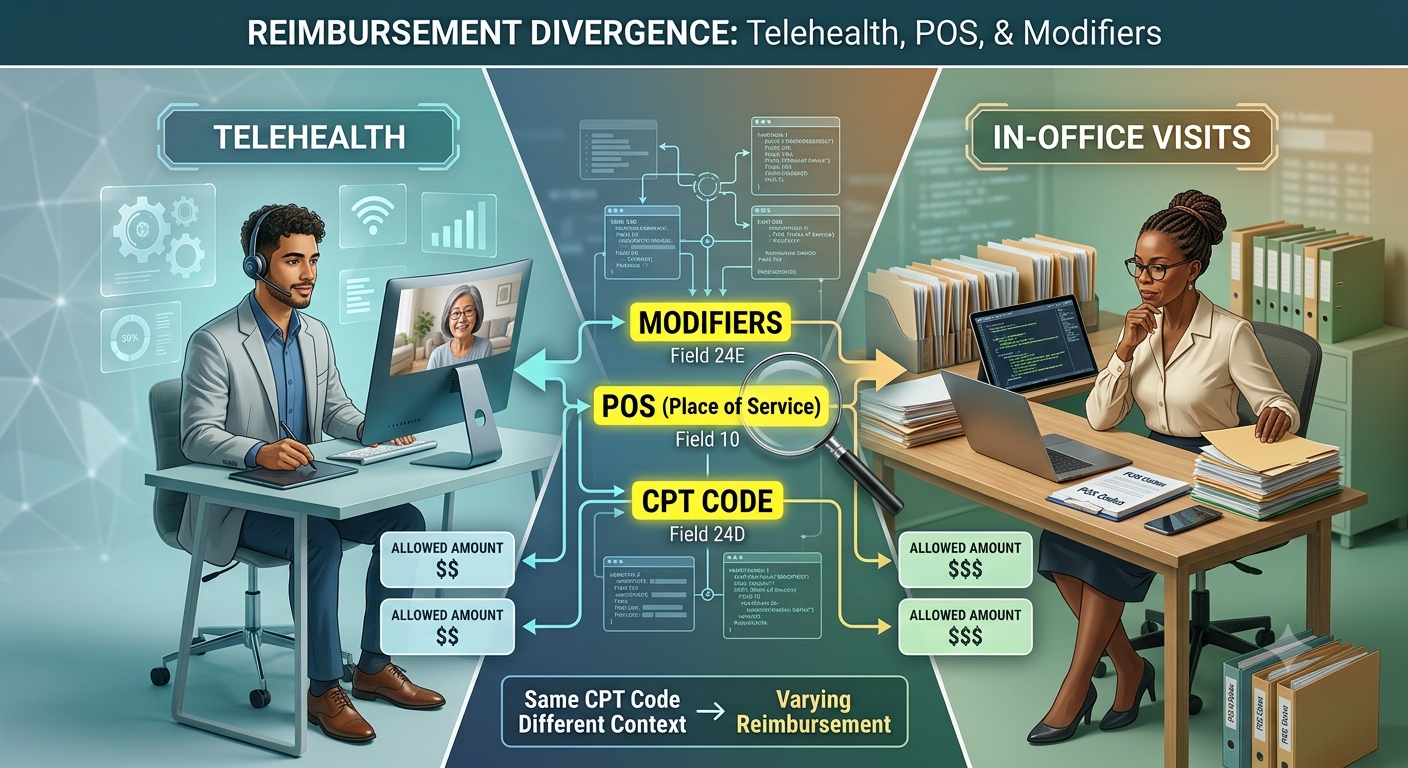
The same CPT code, billed for the same service, can process two different ways — and the reason is rarely the code itself.
It is the context around the code: whether the visit was telehealth or in-office, which place-of-service code was used, which modifier was appended, which provider delivered it, and which plan the patient carried. Change any of those, and an identical procedure code can land at a different allowed amount, hit a different policy, or deny outright.
Earlier in this series we established that the allowed amount is the number to watch, and that testing codes deserve their own review. This article is about the claim details that sit underneath the code — the ones that quietly decide how a claim is priced.
Why Identical Codes Process Differently
A CPT code names the procedure. It does not, on its own, tell the payer the full story of how the service was delivered. That story is carried by the surrounding fields on the claim: place of service, modifiers, rendering provider, and the patient's plan.
Payers use those fields to apply the correct policy and price. Two claims with the same CPT code but different place-of-service codes may be governed by entirely different reimbursement rules. Two claims with the same code but different modifiers may be adjudicated under different policies. This is by design — the fields exist precisely so that context can change how a claim is handled.
For behavioral health, where telehealth is now a routine delivery mode rather than an exception, this matters more than ever. A practice that delivers the same therapy service both in the office and over video is generating two streams of claims that may not price identically — and may not change identically when a payer updates policy.
Telehealth Modifier Review
Telehealth claims typically carry modifiers that signal the service was delivered remotely. These modifiers are not cosmetic. They can determine whether a claim is recognized as telehealth at all, which policy applies, and how it prices.
The review question is not "which modifier do we use" — that is payer-specific and changes over time. The review question is consistency and correctness:
Are telehealth claims carrying the modifier the payer currently expects for that service and date of service?
Has a payer changed its modifier expectations, and did the practice's claims follow?
Are telehealth modifiers applied consistently, or do identical services sometimes go out with the modifier and sometimes without?
When a telehealth claim denies or prices unexpectedly, is the modifier the first thing checked?
Modifier expectations for telehealth have shifted repeatedly in recent years, and they can differ by payer. A modifier that was correct last year may not be correct this year. This is exactly the kind of quiet change that a claims review catches and an announcement may not.
Place of Service Review
The place-of-service (POS) code tells the payer where the service occurred. For telehealth, the POS code has been a moving target — payers have revised which POS codes they expect for remote services, and the choice can affect how the claim prices.
The discipline here mirrors the modifier review:
Are telehealth claims using the POS code the payer currently expects?
Does the POS on the claim match the modifier and the actual delivery setting?
When a payer revises its telehealth POS policy, do the practice's claims reflect the change on the correct effective date?
Are in-office and telehealth claims for the same code carrying different, correct POS codes — or has one setting's convention accidentally been applied to both?
A POS mismatch is one of the most common reasons an otherwise-correct telehealth claim prices unexpectedly or denies. It is also one of the easiest to miss, because the CPT code looks right.
Provider Type and Plan Variation
Two more variables shape how a claim prices, independent of the code.
Provider type and credential. The same service delivered by different provider types may be priced differently, and some services carry payer requirements about which credentials may perform and bill them. A claims review should confirm that reimbursement patterns by provider type match expectations, and that no provider-type pricing surprise is hiding in the data.
Plan and network. The same code, same setting, same provider can price differently across the patient's plan and network. A shift in payer mix — more high-deductible plans, a different network blend — can move aggregate reimbursement even when every contracted rate is unchanged. This is why segmentation, covered throughout this series, is essential: a blended average hides variation that only appears when you separate the claims.
Compare Telehealth and Office Claims Separately
This is the operational heart of the article, and it is a single instruction:
Never review telehealth and in-office claims for the same code as one pool.
They can price differently, follow different policies, carry different modifiers and POS codes, and change on different schedules. Averaging them together produces a number that describes neither accurately and hides changes in both.
A sound review separates them from the start:
Split each CPT code into telehealth and in-office segments before comparing anything.
Within each segment, hold provider type, POS, modifier, and plan constant — compare like to like.
Track the segments over time independently, so a policy change affecting only telehealth is visible immediately rather than diluted by stable in-office claims.
Sort by date of service, not paid date, so a mid-period policy change lands in the correct window.
When a payer changes a telehealth policy — a modifier expectation, a POS requirement, a pricing rule — a practice that reviews telehealth as its own segment sees it right away. A practice that blends telehealth into a general average may not see it until the annual review, if at all.
Bottom Line
The CPT code is only part of a claim. Place of service, modifiers, provider type, and plan decide how that code is actually priced — and for behavioral health practices delivering care both in-office and by telehealth, those details are where reimbursement quietly diverges.
Review telehealth claims as their own segment. Confirm modifiers and place-of-service codes against current payer expectations. Compare like to like. And when a telehealth claim prices unexpectedly, look at the context fields before you look at the code.
The details underneath the code are where the reimbursement story is really told.
Related reading: [Blog 1 — Your Payer Rate May Have Changed] · [Blog 2 — Annual vs. Quarterly Fee Schedule Updates] · [Blog 3 — Allowed Amount: The Claims Data Point to Watch] · [Blog 4 — Testing Codes Deserve Their Own Review]
CBI Center for Education supports the long-term development of mental health professionals through education, consultation, and research. This series offers practical guidance on behavioral health reimbursement awareness, documentation, testing workflow review, and operational decision-making. Explore CBI Center for Education courses and resources designed to help clinicians and behavioral health organizations keep improving the care they provide.
Compliance Note
This series is for educational purposes only and is not legal, coding, billing, payer-contract, or compliance advice. CPT coding, coverage, authorization, documentation, provider eligibility, modifiers, place-of-service codes, and reimbursement vary by payer, contract, region, plan, provider type, place of service, and date of service. Behavioral health organizations should confirm payer policy, contract terms, current CPT and modifier guidance, state scope-of-practice requirements, and internal compliance standards before changing any billing workflow. Codes and modifiers referenced are for illustration only and do not constitute coding instructions.